

How Maritime Antennas Keep Ships Connected in the Open Ocean
In the vast open ocean, staying connected is not a luxury; it is essential for safety, navigation, and operations. Ships face extreme conditions: violent storms, constant motion, and complete isolation from land-based cell towers. Without reliable communication, crews cannot receive weather updates, report emergencies, coordinate with ports, or maintain navigation accuracy. Maritime antennas solve this problem by enabling stable satellite links, VHF radio, AIS tracking, GPS positioning, and high-speed internet even thousands of miles from shore.
What Are Maritime Antennas?
Maritime antennas are specialized wireless devices built to withstand harsh marine environments while providing reliable signal transmission and reception. Unlike land-based antennas, they must resist salt corrosion, high winds, wave-induced motion, and temperature extremes.
They send and receive different kinds of wireless signals so the ship stays safe, connected, and on the right path. These antennas support multiple systems:
- VHF/UHF: Short-range radios for voice calls between ships or with shore stations (like coast guards or ports). Range is usually 20–50 km, similar to a strong walkie-talkie for sea use.
- Satellite communication (SATCOM): Connects the ship to satellites in space for internet, email, phone calls, and data. It works far from land, so crews can contact family, get weather reports, or handle business.
- AIS (Automatic Identification System): Acts like an automatic ship ID broadcast. AIS automatically broadcasts a ship’s name, position, speed, direction, and destination every few seconds. Nearby ships and shore stations see this on screens to avoid collisions and track vessels.
- GPS and GNSS: GPS (U.S.) and GNSS (including GPS, GLONASS, Galileo, BeiDou) use satellites to show a ship’s exact location, speed, and time anywhere on Earth. They help captains follow safe routes.
Regular antennas (like those on houses or cars) are not strong enough for the ocean. High-quality marine antennas ensure clear signals, stable connections, and uninterrupted operations, making them critical equipment for commercial vessels, fishing boats, yachts, cruise ships, research vessels, and offshore platforms.
Why are they so important?
Without good maritime antennas:
- Ships cannot talk to other vessels or shore in an emergency.
- Navigation becomes dangerous (no accurate GPS or AIS).
- Crew cannot get weather warnings or medical help.
- Business operations (cargo tracking, engine monitoring, crew welfare) stop working.
In short, maritime antennas are the “ears and mouth” of the ship in the middle of the ocean. They make sure the crew stays safe, the ship stays on course, and everyone stays connected — no matter how far from land they are.
How Maritime Satellite Antennas Work
Maritime satellite antennas are precision-engineered to maintain a stable link with satellites orbiting thousands of kilometers above Earth, despite the ship's constant pitching, rolling, and yawing.
1. Stabilization and Tracking
The ship rocks a lot from waves. The ship antenna has a special three-axis system with gyroscopes (like spinning sensors) and motors. These detect the ship's movement and move the antenna the opposite way to keep it pointed exactly at the satellite. A smart tracking system watches the signal strength all the time and makes tiny adjustments so the connection never breaks—even in big storms.
2. Signal Conversion and Amplification
Signals from space are very weak after traveling so far. The antenna system handles this through:
- Sending (Uplink): The ship’s modem sends data to a device called Block Upconverter (BUC). The BUC changes the low-frequency signal to a high-frequency one and makes it much stronger so it can reach the satellite. This high frequency is usually in the Ku-band (12–18 GHz) or Ka-band (26–40 GHz).
- Receiving (Downlink): The antenna dish catches the weak signal from space and focuses it onto a device called Low Noise Block downconverter (LNB). The LNB cleans the noise, makes the signal stronger, and changes it to a lower frequency so the ship’s equipment can use it.
3. Beamforming and Polarization
The parabolic dish uses geometric focusing to concentrate signals at the feed horn. Polarization matching (horizontal, vertical, or circular) ensures the antenna aligns with the satellite's signal phase, preventing loss or interference.
These mechanisms allow ships to maintain broadband internet, voice calls, and data links even in severe weather.
Common Types of Maritime Antennas
Different vessels have different needs. Here are the three main types:
1. Starlink Maritime (Electronic Phased-Array Antennas)
These are flat antennas with no moving parts. They use electronic signals to follow low-Earth-orbit (LEO) satellites.
- Advantages: Low latency (<50 ms), high speeds (up to 200+ Mbps download), compact design, easy installation.
- Drawbacks: Sensitive to obstructions (masts, radar domes), coverage still expanding in polar regions.
- Best for: High-bandwidth needs like video streaming and crew welfare on modern commercial vessels.
2. Traditional VSAT Parabolic Antennas (Ku/Ka-Band GEO Systems)
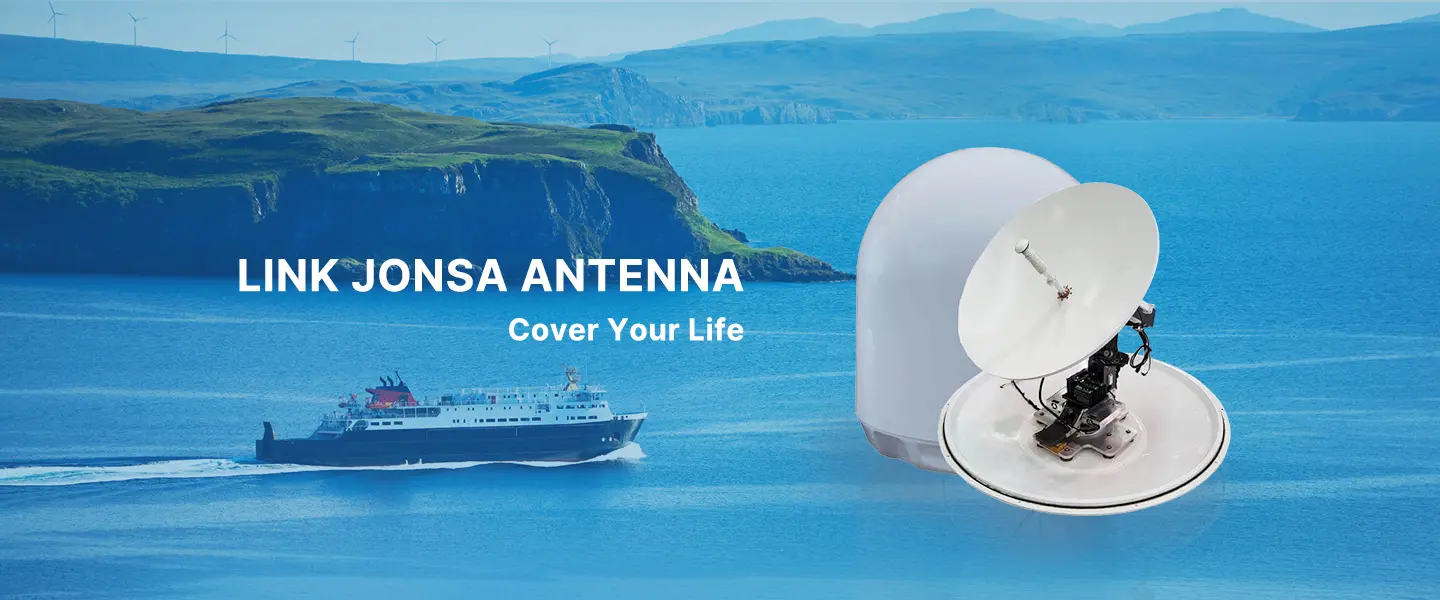
These are round dish antennas inside a protective dome (radome). They point at far-away geostationary satellites.
- Advantages: Global coverage, mature technology, reliable support networks, suitable for long-haul voyages.
- Drawbacks: Slower response (about 600 ms delay), larger size, higher cost.
- Best for: Commercial shipping, large yachts, and operations requiring stable connectivity.
3. L-Band Omnidirectional Antennas
Small, dome-shaped antennas using L-band satellites.
- Advantages: Near-global coverage (including poles), high reliability in bad weather, minimal rain fade.
- Drawbacks: Low speed (176–704 kbps), high data costs.
- Best for: Safety, backup, emergency calls, small boats, and ships that need connection in extreme conditions.
Applications of Maritime Satellite Antennas
Maritime antennas serve different roles depending on the vessel type.
Cruise Ships
Cruise ships carry thousands of passengers who want to stay connected. Passengers use Wi-Fi to stream movies, watch videos, use social media, and make video calls home. The antenna must handle many people online simultaneously (hundreds of connections). Crew also use it to coordinate work, communicate, and run safety systems like emergency alerts. Without strong satellite internet, passengers would be unhappy, and the ship could not operate smoothly.
Fishing and Commercial Vessels
Captains get real-time weather reports to avoid storms and bad conditions. They send catch reports (how much fish they caught) to companies or government. Crew can call family or get medical help if someone is sick. Ships monitor engines and machines to fix problems early.
Military and Research Ships
Secure, encrypted channels transmit sensitive data, coordinate missions, and support scientific instruments. Antennas must be rugged and jam-resistant.
FAQs
Q1. Which frequency band should I choose — L-Band, Ku-Band, or Ka-Band?
A: It depends on your needs:
L-Band (Iridium/Inmarsat): Best for global coverage, extreme weather reliability, and safety/backup (low speed, high cost per MB).
Ku-Band: Balanced speed and cost, good for standard ship operations and crew internet.
Ka-Band: Highest speeds (fiber-like), ideal for high-bandwidth demands like streaming or large crews.
How to choose:
Look at your ship's route (where you sail), how much data you need, and your budget.
- Safety first? → L-Band
- Normal daily use? → Ku-Band
- Very fast internet? → Ka-Band
Q2. How does antenna size affect performance?
A: Larger dishes (1 m+) offer higher gain, better signal in bad weather, and higher speeds. Smaller antennas (45–60 cm) are easier to install and lighter but may lose signal in heavy rain or at the edge of coverage. When budget and installation space allow, choosing an antenna size slightly larger than the minimum required can effectively improve system reliability and resistance to weather interference.
Conclusions: Reliable Connectivity When It Matters Most
Maritime antennas are the lifeline that keeps ships connected in the open ocean. They enable safety communications, precise navigation, operational efficiency, and crew welfare. From Starlink’s low-latency phased arrays to traditional VSAT domes and reliable L-Band backups, modern marine antennas deliver connectivity in the harshest environments.
For dependable ship antenna solutions, JONSA offers high-performance CPE antennas, including the M060 and M090. These weather-resistant, corrosion-proof antennas provide strong gain, wide coverage, and reliable performance for maritime and offshore applications. JONSA is one of the leading marine antenna manufacturers in Taiwan. Contact us for the right marine antenna to keep your operations connected wherever you are on the sea.